
Time: 2026-05-14 Click: 281 seen
An industrial boiler PLC control system refers to a comprehensive intelligent system that uses a PLC (Programmable Logic Controller) to automatically monitor, control, and protect boiler operations. Its primary function is to ensure the safe, stable, and efficient production of steam or hot water, thereby making the boiler a predictable and reliable industrial asset.
A PLC (Programmable Logic Controller) is an automation control device used in industrial applications.
In boiler systems, it receives signals from various sensors to automatically adjust equipment operating conditions, ensuring safe, stable, and efficient operation.
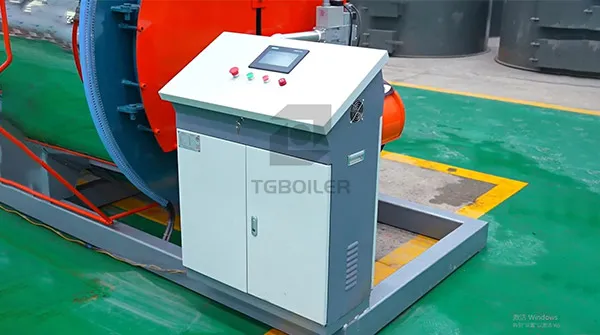
A complete PLC boiler control system typically includes:
PLC Main Controller: The core control unit responsible for logical operations and instruction execution
Sensor System: Monitors key parameters such as pressure, temperature, water level, and flow rate
Actuators: Such as burners, water pumps, valves, and fans
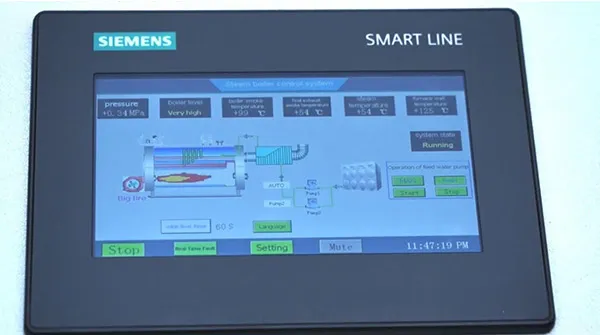
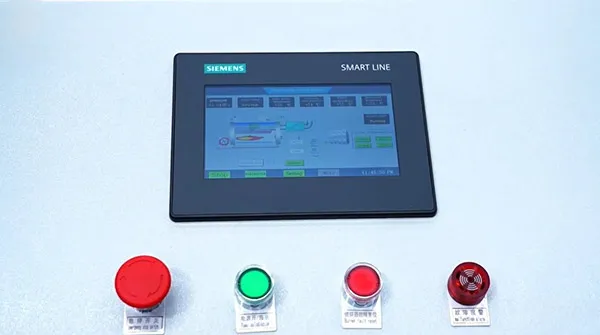
Human-Machine Interface (HMI): Used for operation, monitoring, and data display
Alarm and Protection System: Automatically triggers alarms or shuts down the system in case of abnormalities
Input: The sensor system collects real-time signals for pressure, temperature, water level, flow rate, etc., and sends them to the PLC for comparison with setpoints.
Processing: The PLC performs calculations and processes the signals according to a pre-set logic program.
Output: Sends output signals to actuators, such as feedwater pumps (water level), forced draft/induction fans (combustion), and control valves (flow rate), to maintain the process within the required parameter ranges.
1️⃣ Automatic Operation Control
Enables fully automatic operation, including boiler start/stop, combustion adjustment, and water level control.
2️⃣ Safety Interlock Protection
When extremely low water levels, overpressure, or combustion faults are detected, the PLC automatically triggers an alarm or initiates an emergency shutdown.
3️⃣ Improved Efficiency
Enables precise control of the fuel-to-air ratio, improving combustion efficiency and reducing energy consumption
4️⃣ Reduced Labor Costs
Automated operating system reduces labor costs
| Item | PLC-Controlled Boiler | Traditionally Controlled Boiler |
| Level of Automation | High | Low |
| Safety | High (multiple protections) | Lower |
| Operational Difficulty | Simple | Relies on experience |
| Operational Efficiency | High | Average |
👉 Conclusion: Modern industrial boilers almost universally adopt PLC control systems
Intelligent Operation: One-button startup, automatic adjustment
Stable and Reliable: Industrial-grade design, suitable for complex industrial environments, high safety
High Efficiency and Energy Savings: Optimized combustion, improved boiler thermal efficiency, energy conservation
Remote Monitoring: Supports networking and data management.
The PLC control system for industrial boilers is the core technology for achieving automated, intelligent, and safe boiler operation.
For modern factories, adopting PLC control not only improves production efficiency but also effectively reduces operating costs and safety risks.
As a professional boiler manufacturer, TGBOILER integrates advanced PLC systems into every unit to ensure maximum safety and efficiency.
Whether you are looking to upgrade your current system, or plan a new industrial energy project, our global engineering team is here to help.
📩 [Contact TGBOILER Engineering Team for a Free Custom Solution & Quote]
Email: info@taiguoboilers.com WhatsApp: +86 13598899826
Tel/Fax: 0086 371 63311291
WhatsApp/WeChat: 0086 13598899826
Email:info@taiguoboilers.com
Add: No.6 Zone, North Side of Konggang No.6 Road, Airport Economy Zone, Zhengzhou City, Henan Province, China




 0086 13598899826
 0086 13598899826
 info@taiguoboilers.com
