
Time: 2026-11-12 Click: 3 seen
In the industrial sector, saturated steam boilers are common heat source supply equipment specifically designed to generate and deliver saturated steam.
When water is heated to boiling point under a specific pressure and transforms into steam, if the steam and water coexist in a state of thermodynamic equilibrium, the steam is referred to as saturated steam.
1. Constant-Pressure Heating and Boiling: Water inside the boiler is heated to the boiling temperature at that pressure (known as the saturation temperature), at which point the water begins to vaporize.
2. Temperature-Pressure Correspondence: In a saturated state, pressure and temperature correspond one-to-one (for example: 1 bar corresponds to approximately 100°C; 10 bar corresponds to approximately 180°C). If the pressure increases, the temperature rises accordingly.
3. Steam-Water Quality: Steam exiting the boiler drum or evaporation surface is typically dry saturated steam or wet saturated steam containing trace amounts of moisture; it does not undergo additional heating via a “superheater.”
Temperature Stability: At a given operating pressure, the temperature of saturated steam remains constant; as long as the pressure remains unchanged, heat release relies primarily on the latent heat of the steam.
High Heat Transfer Efficiency: Latent heat is released uniformly, making it ideal for processes requiring constant-temperature heating.
Simple Structure: The superheater system is eliminated, resulting in a simpler boiler design, easier operation and maintenance, and lower initial costs.
Humidity Control: High-quality saturated steam boilers are typically equipped with efficient steam-water separators (such as cyclone separators or corrugated plate separators) to ensure high dryness of the output steam, thereby reducing water hammer in pipelines and equipment corrosion.
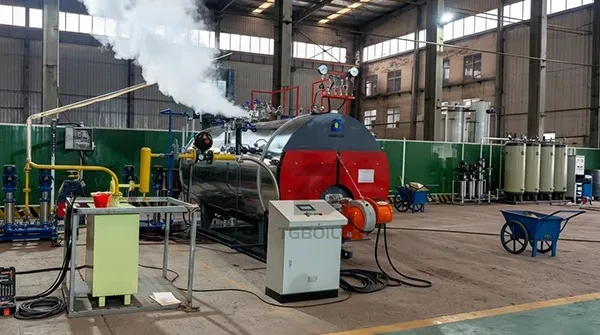
Saturated steam boilers: The steam temperature produced equals the saturation temperature at that pressure. These boilers feature a relatively simple structure, a stable heat source, and rapid latent heat release.
Superheated steam boilers: Building on saturated steam, the steam is further heated via a superheater to raise its temperature above the saturation temperature at that pressure. These boilers are primarily used to drive steam turbines in large power plants to improve cycle efficiency.
Due to its stable temperature and high latent heat (which is released at a constant temperature), saturated steam is widely used in industries that require high temperature precision but do not need extremely high-temperature heat sources:
Food processing: steaming, sterilization, disinfection, and drying.
Textile printing and dyeing: sizing, dyeing, and setting heat.
Pharmaceuticals and chemicals: reactor heating, pipeline insulation, and steam for basic processes.
Papermaking and rubber: pressing and drying, vulcanization, etc.
Tel/Fax: 0086 371 63311291
WhatsApp/WeChat: 0086 13598899826
Email:info@taiguoboilers.com
Add: No.6 Zone, North Side of Konggang No.6 Road, Airport Economy Zone, Zhengzhou City, Henan Province, China




 0086 13598899826
 0086 13598899826
 info@taiguoboilers.com
