
Time: 2026-06-25 Click: 135 seen
Boiler equipment plays a vital role in both industrial and residential settings. With a wide variety of boilers currently available on the market, this article will introduce the different types of boiler equipment from multiple perspectives.
Power Plant Boilers: Primarily used in large thermal power plants or regional combined heat and power (CHP) facilities.
Industrial Boilers: Widely used in industries such as chemical processing, food and beverage processing, pharmaceuticals, textiles, papermaking, and oil refineries.
Residential Boilers: Used for space heating and domestic hot water supply in residential buildings (single-family and multi-family homes), office buildings, hospitals, and educational institutions.
Special-Purpose and Other Boilers: Marine boilers specifically designed to power ships; and waste heat boilers that recover industrial waste heat.
Boilers are primarily divided into fire-tube boilers and water-tube boilers. Fire-tube boilers include vertical and horizontal types, while water-tube boilers include horizontal and vertical types.
Gas-fired boilers: Use clean energy sources such as natural gas and liquefied petroleum gas (LPG); they are environmentally friendly and highly automated.
Oil-fired boilers: Fueled by diesel, heavy oil, and similar fuels, they start up quickly and are commonly used in locations without district heating networks or for backup heating needs.
Coal-fired boilers: Fueled by coal, they offer lower costs; however, due to environmental regulations, they typically employ combustion methods such as layer combustion, chamber combustion, or circulating fluidized bed combustion.
Biomass boilers: These burn agricultural waste (such as wood chips and crop straw) and utilize renewable energy sources.
Electric boilers: These convert electrical energy into thermal energy, producing no pollution or emissions, and feature a very compact design.
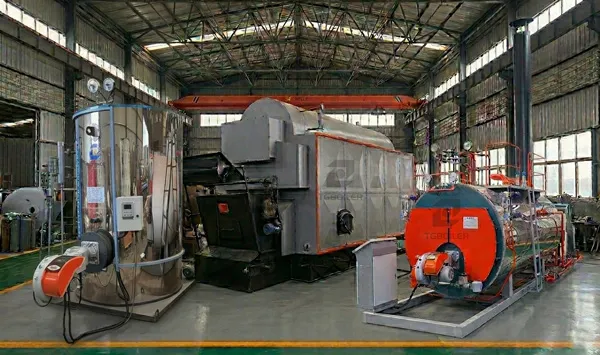
Boilers with an evaporation rate of less than 10 t/h are classified as small boilers; those with an evaporation rate between 10 and 50 t/h are classified as medium-sized boilers; and those with an evaporation rate greater than 50 t/h are classified as large boilers.
Boilers with a pressure below 2.5 MPa are classified as low-pressure boilers; those above 6.0 MPa are classified as high-pressure boilers; and those with pressures between the two are classified as medium-pressure boilers. In addition, there are ultra-high-pressure boilers, subcritical boilers, and supercritical boilers.
Boilers are classified as natural circulation boilers and forced circulation boilers (including direct-flow boilers). Water circulation is a critical factor in ensuring the safe cooling of heat transfer surfaces.
Boilers are classified as prefabricated boilers, modular boilers, and bulk boilers. In addition, there are vacuum boilers, modular boilers, and others.
Classifying industrial boilers across these 7 dimensions is the first step. However, customizing the system for your specific factory requires expert engineering. Consulting with an experienced, global manufacturer like [Henan Taiguo Boiler Manufacturing Co., Ltd.] can help you optimize your plant’s thermal efficiency and reduce long-term operational costs.
For more information about boilers, please contact:
Email: info@taiguoboilers.com
WhatsApp: +86 13598899826
Tel/Fax: + 86-371-6331 1291
WhatsApp/WeChat: 8613598899826
Email:info@taiguoboilers.com
Add: 13th Floor, Building B, Zhengshang Xuefu Square, No. 277 Boxue Road, Zhengdong New District, Zhengzhou, Henan, China




 8613598899826
 8613598899826
 info@taiguoboilers.com
