
Time: 2026-07-23 Click: 128 seen
In industrial biomass applications, biomass boilers primarily use three combustion methods: grate firing, chamber firing, and fluidized bed combustion. Among these, grate firing is the most mature combustion technology, offering the highest return on investment (ROI) and the simplest maintenance.
Let’s examine the practical implementation of these three biomass boiler combustion methods:
Fluidized-bed boilers: Although they offer extremely high thermal efficiency, equipment costs often start in the millions, electricity consumption is very high, and operation is extremely complex. They are only suitable for large power plants or large-scale projects exceeding 35 tons.
Gasification boilers: These have extremely stringent requirements for fuel size and moisture content; if the fuel does not meet these standards, tar buildup can easily clog the pipes.
Grate-fired boilers: The best value for money! With moderate capital investment, a simple and durable design, minimal operator skill requirements, and broad fuel adaptability, they are the primary choice for replacing natural gas or coal in industries such as textiles, food processing, wood processing, and chemicals.
Layer combustion (firebed combustion): Fuel is placed on a grate, air flows through from beneath the grate, and the fuel burns in layers on the grate surface.
Common types of biomass layer-fired boilers include: chain grate boilers, reciprocating grate boilers, vibrating grate boilers, and fixed grate boilers.
Among these, chain grate and reciprocating grate boilers are the most mainstream types of layer-fired boilers.
The choice between a “chain” or “reciprocating” grate depends primarily on your fuel type and budget: if the fuel is a single type and of high quality (such as pure wood pellet), choose a chain grate boiler; if the fuel is complex and prone to slagging (such as bark or crop straw), a reciprocating grate boiler is strongly recommended.
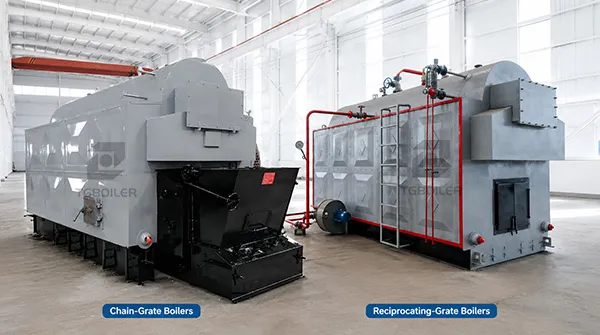
Chain Grate vs. Reciprocating Grate: Comprehensive Comparison
| Comparison Dimension | Chain Grate Boiler | Reciprocating Grate Boiler |
| Working Principle | Continuous forward movement (crawling belt style) without relative shear force. | Stepped reciprocating staggered motion, providing shear, agitation, and flipping action. |
| Best Suited Fuels | Uniform and free-flowing fuels (wood pellets, small wood chips, compressed briquettes). | Irregularly shaped, high-slagging, and high-moisture fuels (palm kernel shell/PKS, raw rice husk, crop straw, bark). |
| Anti-Slagging Ability | Moderate (if fuel melts easily, clinkers/slag can accumulate on the grate and block airflow) | Exceptional (reciprocating shear forces actively break up slag, preventing large clinker formation). |
| Fuel Moisture Tolerance | Recommended moisture $< 20\%$ | Tolerates higher moisture levels (up to $30\% - 45\%$). |
| Initial Investment | Lower (relatively simple and mature mechanical structure). | Slightly Higher (due to mechanical drive systems and heat-resistant high-chromium grate bars). |
| Maintenance Difficulty | Very Low (standardized, highly versatile components). | Low (highly durable, though grate bar wear should be periodically monitored). |
Prioritize chain grate boilers: If the local supply of biomass pellets is ample and reasonably priced, and if the boiler capacity is not large and the goal is to minimize initial investment.
Prioritize reciprocating grates: If fuel sources are diverse, you frequently co-fire different types of biomass, or the fuel has high moisture content and is prone to slagging (e.g., crop straw with high alkali metal content). Although the initial investment is higher, these systems offer stable long-term operation, low failure rates, and lower fuel costs.
There is no single “best” combustion method—only the grate design best suited to your fuel.
Chain grates help you control initial investment costs, while reciprocating grates help you fully utilize low-cost waste materials and break up coke deposits. Choosing the right technical approach will save you far more in annual fuel costs than the price difference between the equipment models.
Planning a biomass thermal energy project?
📩 Submit your steam tonnage requirements and fuel type now to receive a free, customized selection plan and detailed comparative quotes!
Email: info@taiguoboilers.com WhatsApp: +86 13598899826
Tel/Fax: 0086 371 63311291
WhatsApp/WeChat: 0086 13598899826
Email:info@taiguoboilers.com
Add: No.6 Zone, North Side of Konggang No.6 Road, Airport Economy Zone, Zhengzhou City, Henan Province, China




 0086 13598899826
 0086 13598899826
 info@taiguoboilers.com
