
Time: 2025-10-30 Click: 412 seen
Fire-tube boilers and water-tube boilers are common types of industrial boilers, each with distinct characteristics and drawbacks. Customers can select the appropriate boiler based on their specific application. Below
are four key differences between fire-tube and water-tube boilers:
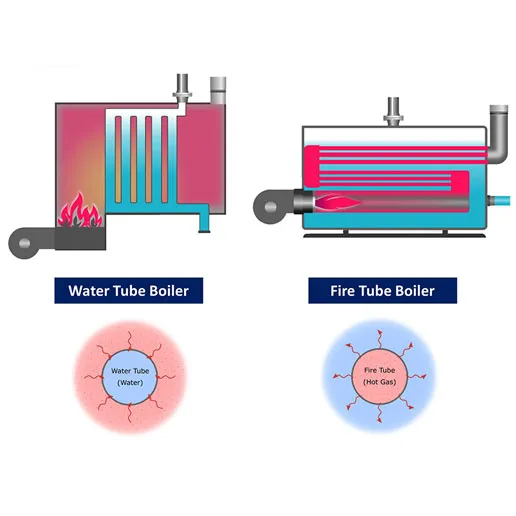
1. Different Media
Water-tube boilers feature fire surrounding water, where water inside the tubes is heated by convection from external high-temperature flue gases.
Fire-tube boilers feature water surrounding fire, where flue gases circulate within the tubes and heat the water outside the tubes to achieve heat exchange.
2. Different Pressure Ranges
Water-tube boilers accommodate a broader pressure range, capable of exceeding pressure limits to meet steam demands above 2.5MPa. Fire-tube boilers are constrained by material wall thickness and pressure
limitations, typically operating at pressures up to 2.5 MPa.
3. Footprint Differences
Fire-tube boilers feature compact structures. For equivalent output, their external dimensions and equipment weight are lower than water-tube boilers. Water-tube boilers, being larger in size, provide more space for
superheaters. Consequently, they occupy larger boiler rooms.
4. Structural Differences
Fire-tube boilers feature simple construction, large water and steam capacities, and low water quality requirements. They are commonly used in small-scale industrial processes and residential heating.
Water-tube boilers possess large heat transfer surfaces and excellent thermal efficiency, demanding higher water quality standards. Structurally suited for large-capacity, high-parameter applications in major industrial zones.
Both fire-tube and water-tube boilers have distinct advantages and disadvantages. Enterprises should select the appropriate boiler type based on actual requirements.
For more information about boilers, please contact:
Email: info@taiguoboilers.com
WhatsApp: +86 13598899826
Tel/Fax: 0086 371 63311291
WhatsApp/WeChat: 0086 13598899826
Email:info@taiguoboilers.com
Add: No.6 Zone, North Side of Konggang No.6 Road, Airport Economy Zone, Zhengzhou City, Henan Province, China




 0086 13598899826
 0086 13598899826
 info@taiguoboilers.com
